> For the complete documentation index, see [llms.txt](https://docs.mikopbx.com/mikopbx/llms.txt). Markdown versions of documentation pages are available by appending `.md` to page URLs; this page is available as [Markdown](https://docs.mikopbx.com/mikopbx/english/modules/miko/module-callback-queues.md).
# Callback module
This module is designed to handle missed calls automatically. Whenever a missed call is detected, a callback task is created. As soon as an employee becomes available, they receive a call; once they answer, an attempt is made to connect with the client.
Let's walk through the module's functionality with a few examples:
## Missed Call
A client attempted to contact the company but was unable to reach anyone. This might happen for various reasons, such as:
* The call was disconnected.
* The client hung up before anyone answered.
In response, the module generates a callback task. Once an employee becomes available, they receive the task call.
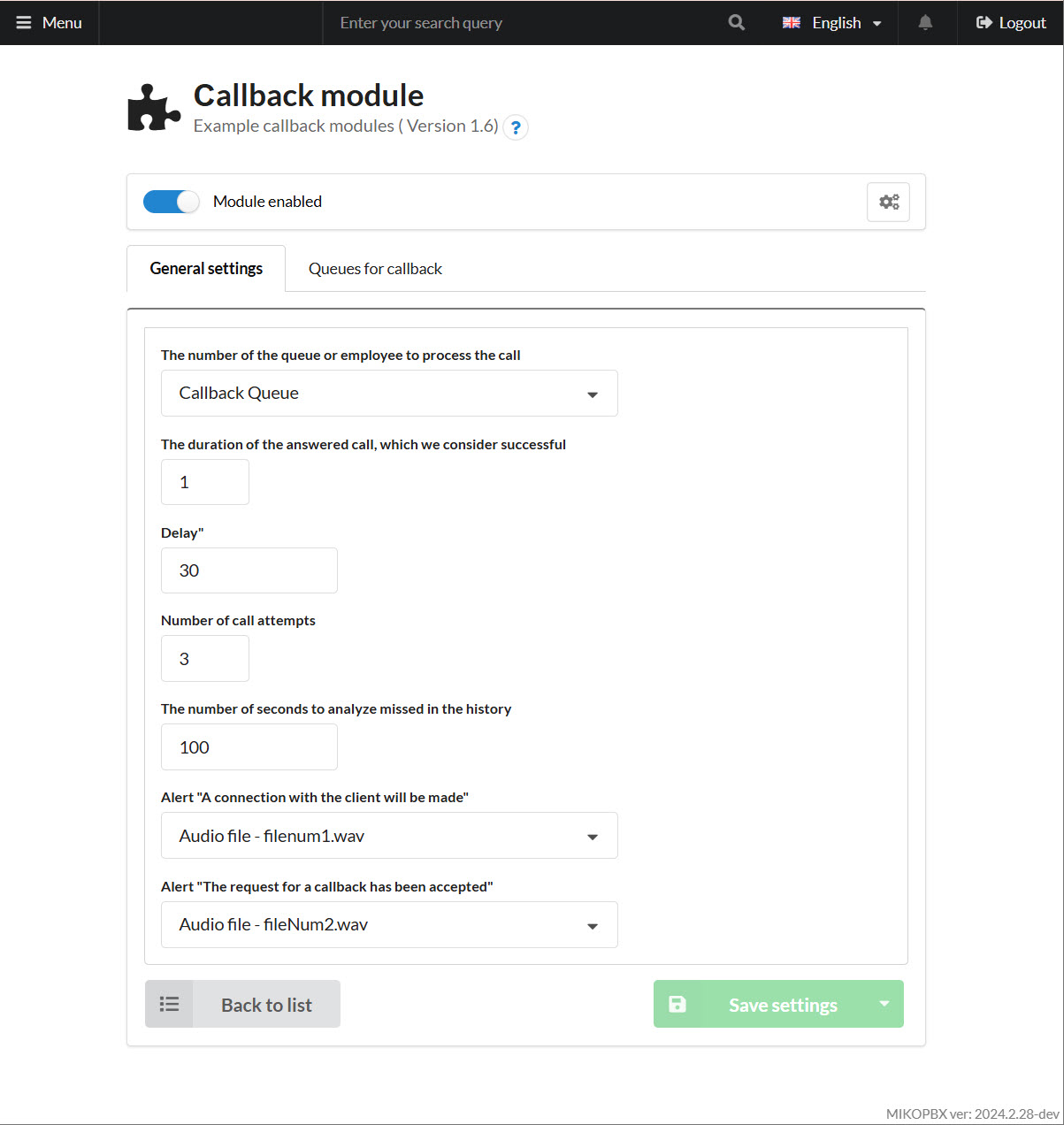
Module overview
An alert sound file can be played for the employee. You can specify this file in the module settings under **Alert "A connection with the client will be made."** After the notification, the system will initiate the client call.
Employees handling missed calls should be added to a shared **Call Queue**. Set the queue number or employee number for handling missed calls in the module settings.
Not every answered call can be considered successful. The module allows you to define a criterion, **The duration of the answered call, which we consider successful.**
If the call is unsuccessful, you can set retry parameters:
* **Delay** – interval between retry attempts
* **Number of call attempts**
Older calls may no longer be relevant, so there is a configurable “expiry time” for missed calls. Calls and tasks older than the set **The number of seconds to analyze missed in the history** will not be processed.
## Callback Request from Client
In cases where a client is tired of waiting and requests a callback, the module can handle it as well. Specify the sound file in **Alert "The request for a callback has been accepted"**
Once the client presses **1**, a callback task is created, and the client hears the confirmation notification. The **Press 1 to request a callback** feature is available in queues listed under **Queues for callback**.
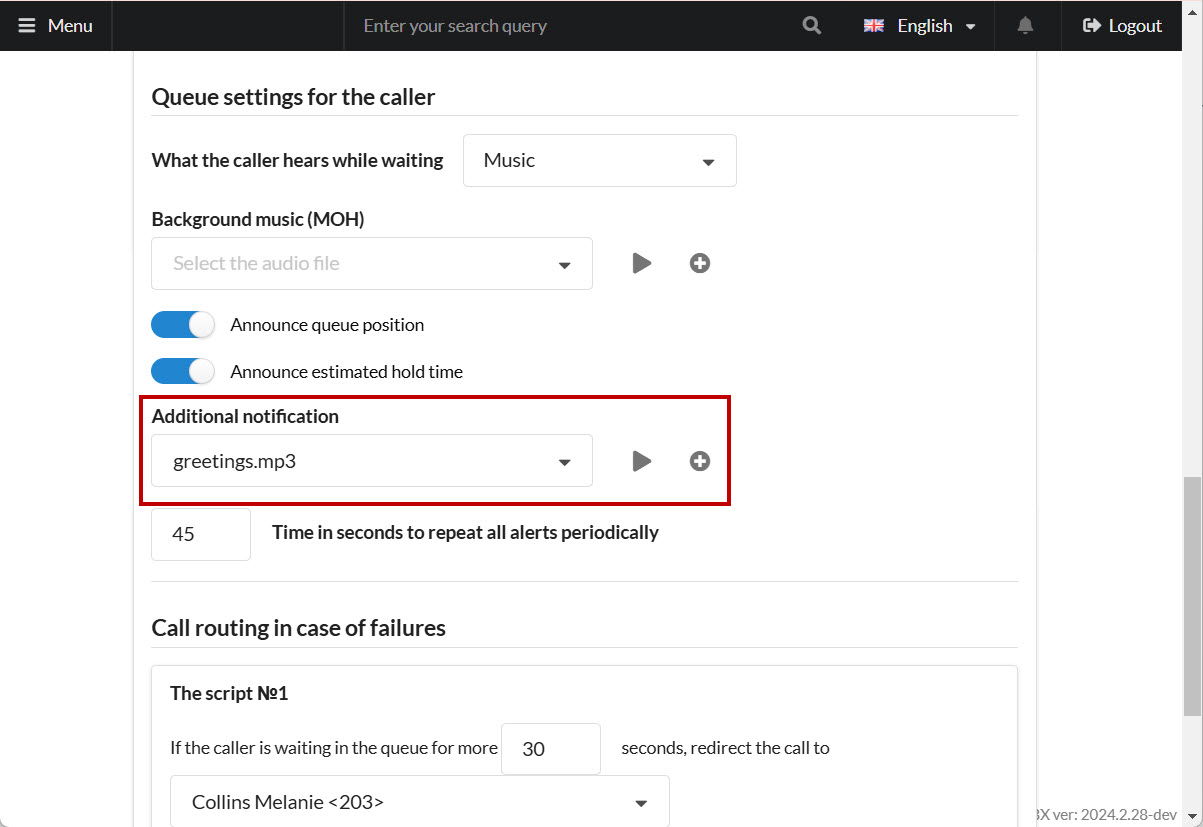
You can also configure additional notifications in the **Advanced** settings for individual queues.
{% hint style="info" %}
The **Ad phrase or additional notification** setting for queues only works when all employees are **busy**.
{% endhint %}
Additional settings in the queue section
This feature can, for instance, prompt the client to press "1" to initiate a callback request.
---
# Agent Instructions
This documentation is published with GitBook. GitBook is the documentation platform designed so that both humans and AI agents can read, navigate, and reason over technical content effectively. Learn more at gitbook.com.
## Querying This Documentation
If you need additional information that is not directly available in this page, you can query the documentation by asking a question.
Perform an HTTP GET request on the following URL with the `ask` and `goal` query parameters:
```
GET https://docs.mikopbx.com/mikopbx/english/modules/miko/module-callback-queues.md?ask=&goal=
```
`ask` is the immediate question: it should be specific, self-contained, and written in natural language.
`goal` is what the user is ultimately trying to achieve, the reason they need the answer. Sharing it helps GitBook give you a better, more relevant answer. A goal is most helpful when it describes the outcome the user wants rather than restating the question. For example, with `ask=how do I create an API token`, a goal like `automate deployments from our CI pipeline` lets GitBook tailor the answer to that use case.
The response will contain a direct answer to the question and relevant excerpts and sources from the documentation.
Use this mechanism when the answer is not explicitly present in the current page, you need clarification or additional context, or you want to retrieve related documentation sections.