> For the complete documentation index, see [llms.txt](https://docs.mikopbx.com/mikopbx/llms.txt). Markdown versions of documentation pages are available by appending `.md` to page URLs; this page is available as [Markdown](https://docs.mikopbx.com/mikopbx/english/faq/troubleshooting/traffic-analysis-using-sngrep.md).
# Traffic Analysis Using Sngrep
**Sngrep** is a command-line tool for capturing and analyzing SIP traffic. It allows you to visualize SIP sessions, filter them, and track issues in voice connections.
{% hint style="info" %}
Use this application to analyze logs and send them to technical support.
{% endhint %}
To start working with the application, follow the SSH connection to the PBX [guide](/mikopbx/english/faq/troubleshooting/connecting-to-a-pbx-using-ssh/putty.md).
To **start** the application, use the command:
```bash
sngrep -r
```
{% hint style="success" %}
If multiple network interfaces are used, specify the interface ID when launching the application:
```bash
bashCopy codesngrep -d eth1 -r
```
The **-r** key allows capturing audio traffic.
{% endhint %}
You can view the list of interfaces using the following command:
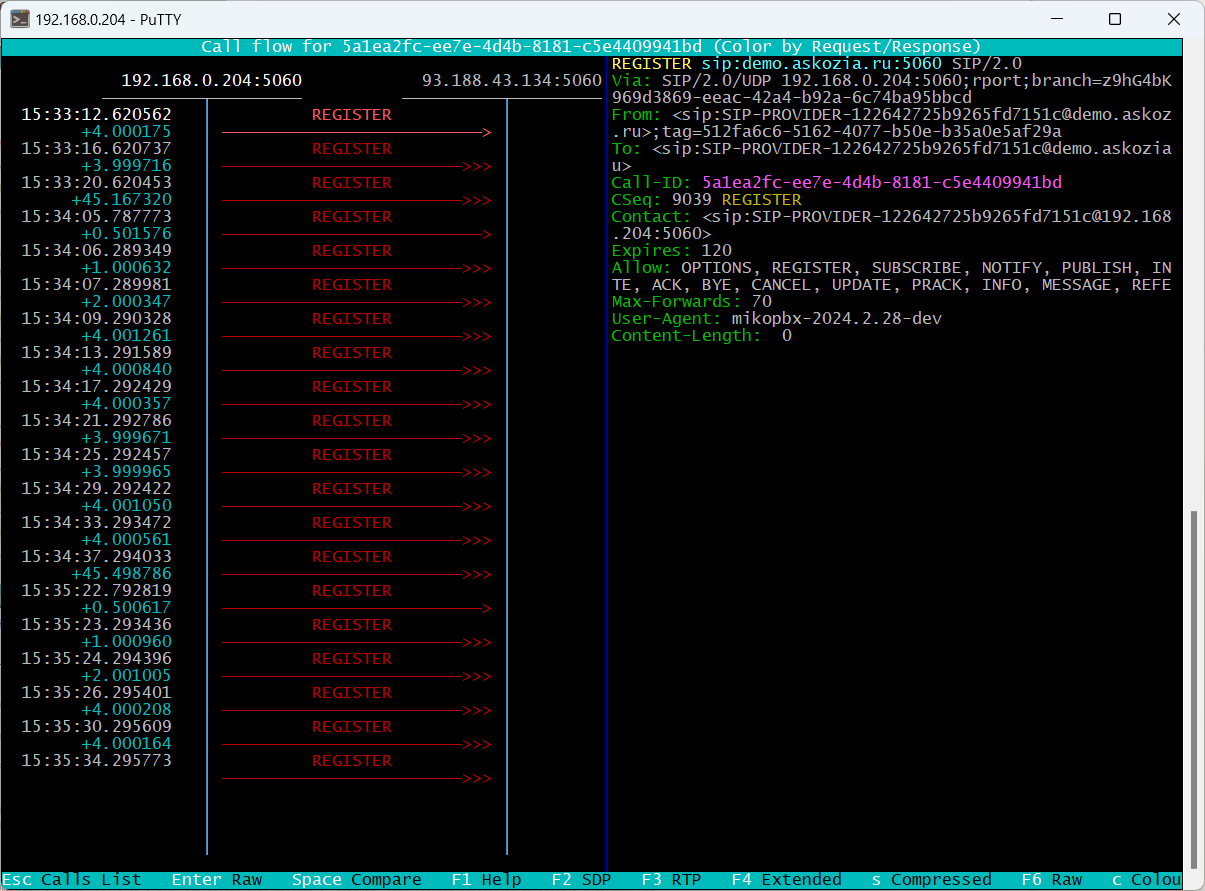
The application window displays a list of all SIP dialogues:
* Use the **⇑** and **⇓** arrows to navigate between dialogues.
* Press **Enter** to view detailed information about a dialogue.
information about the dialogue
* In the detailed view, you can examine specific SIP packets by selecting them with **⇑** and **⇓**.
* Press **Enter** to view the contents of a SIP packet.
Contents of the SIP packet
* Press **ESC** to return to the previous window.
* Use the **Space** key to select multiple SIP dialogues and press **Enter** to view them in one window.
* In the detailed view, use the **Space** key to select two **SIP** packets for comparison.
Comparison of two SIP packages
## Saving a Dump
1. Use the **Space** key to select the SIP dialogue "Call" of interest.
Dialogue "Call"
2. Press **F2** to open the save dump dialogue:
* Use the **⇑** and **⇓** arrows to navigate between form fields.
* Enter the path and file name.
* Select the save action and press **ENTER**.
* Download the file using [SSH connection to the PBX with WinSCP](/mikopbx/english/faq/troubleshooting/connecting-to-a-pbx-using-winscp.md).
#### Filtering
1. Press **F7** to open the filter dialogue:
2. Use the **⇑** and **⇓** arrows to navigate between form fields.
3. Use the **Space** key to select SIP methods for analysis.
4. Select the **Filter** action and press **ENTER**.
---
# Agent Instructions
This documentation is published with GitBook. GitBook is the documentation platform designed so that both humans and AI agents can read, navigate, and reason over technical content effectively. Learn more at gitbook.com.
## Querying This Documentation
If you need additional information that is not directly available in this page, you can query the documentation by asking a question.
Perform an HTTP GET request on the following URL with the `ask` and `goal` query parameters:
```
GET https://docs.mikopbx.com/mikopbx/english/faq/troubleshooting/traffic-analysis-using-sngrep.md?ask=&goal=
```
`ask` is the immediate question: it should be specific, self-contained, and written in natural language.
`goal` is what the user is ultimately trying to achieve, the reason they need the answer. Sharing it helps GitBook give you a better, more relevant answer. A goal is most helpful when it describes the outcome the user wants rather than restating the question. For example, with `ask=how do I create an API token`, a goal like `automate deployments from our CI pipeline` lets GitBook tailor the answer to that use case.
The response will contain a direct answer to the question and relevant excerpts and sources from the documentation.
Use this mechanism when the answer is not explicitly present in the current page, you need clarification or additional context, or you want to retrieve related documentation sections.